The evidence
Three tests, then the scoring question.
Hypotheses 1–3 were specified before structural coefficients were examined. Bayes factors, out-of-fold prediction, the two-factor split, and the neuroticism-adjusted component models were added at the reporting stage and are labeled as such in the paper.
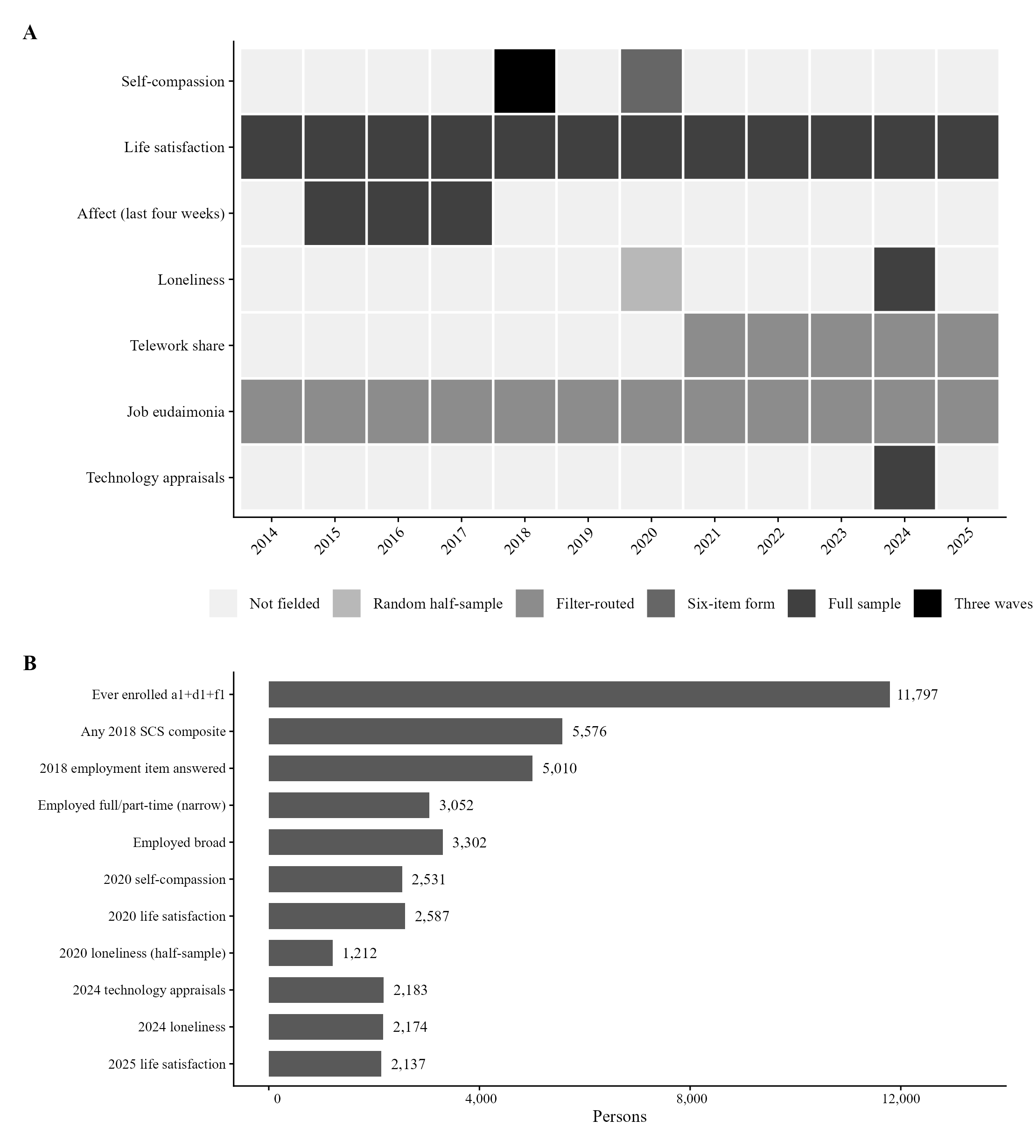
Design timeline
Hypothesis 1 · Disruption
Life satisfaction fell 6.22 points on a 0–100 metric across 2020–2021. The trait was associated with a higher 2020 level (b = 2.16, 95% CI [1.40, 2.91], β = .14) and was not associated with the disruption slope (b = −0.10, 95% CI [−0.71, 0.51], p = .746). 2020 loneliness, administered to a random half-sample (n = 1,212), was unrelated (b = −0.06, p = .166). Bayes factors favored the models without those paths (BF01 = 51.52 and 18.42).
Hypothesis 2 · Telework
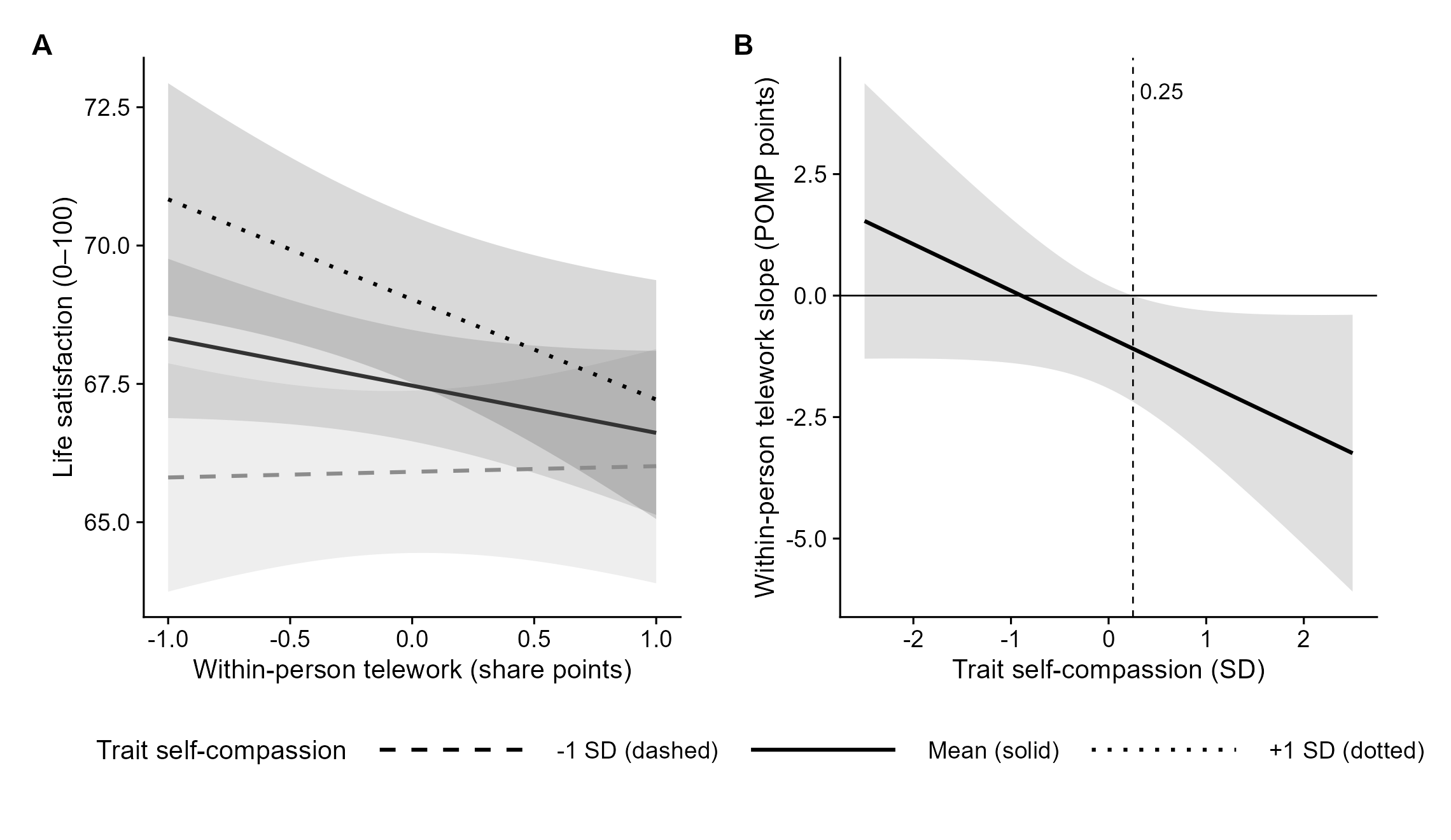
The cross-level interaction of the trait with within-person telework share was not significant, b = −0.96, 95% CI [−2.01, 0.10], p = .076, BF01 = 12.28. The evidence against this path is weaker than for the disruption slope. Simple slopes, which should be read as descriptive because the interaction was not significant, were near zero at −1 SD and negative at +1 SD.
Hypothesis 3 · 2024 technology appraisals
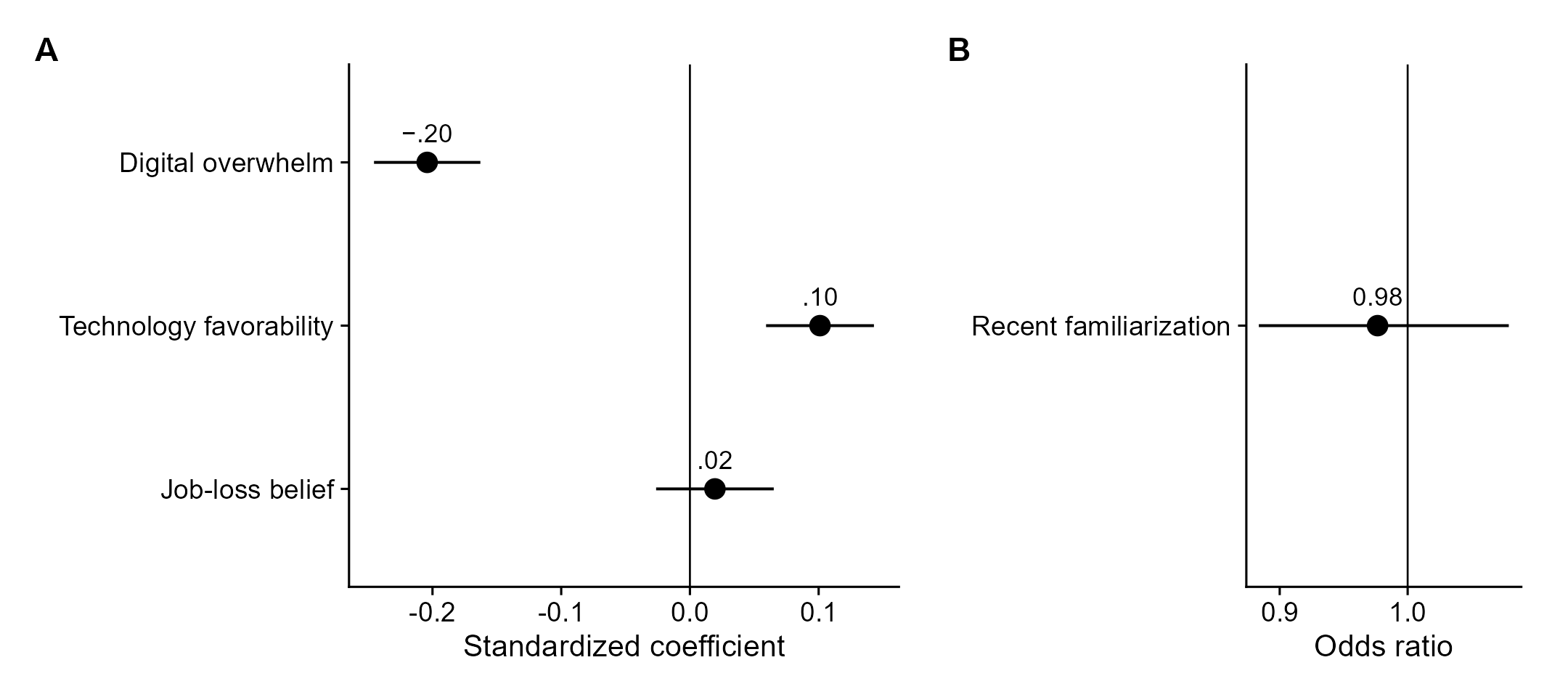
Controlling for prepandemic well-being, age, education, and technology affinity, the trait was associated with lower digital overwhelm (β = −.20) and more favorable appraisals (β = .10). It was not associated with the digitalization job-loss belief or with the odds of recent familiarization (OR = 0.98). Two of four outcomes supported the hypothesis.
The scoring result
- Positive and negative item sets correlated only r = .32–.39. The hypothesized trait factor correlated r = .98 with reverse-scored self-critical items and r = .38 with self-caring items.
- Full-sample component models (estimation N = 3,052): self-critical composite β = −.297 for 2024 loneliness and β = −.213 for overwhelm. Self-caring items entered simultaneously: β = .010 and near zero.
- Six-item Big Five Inventory–2 neuroticism control (2017; n = 1,616 for that check): loneliness β = −.239, overwhelm β = −.169. The two-item BFI-10 control is weaker (α ≈ .47–.54) and is not the better estimate of residual confounding.
- Out-of-fold nested cross-validation: the 2018 composite improved prediction of 2024 loneliness (ΔR² = .036) and, more modestly, overwhelm (ΔR² = .008). It did not improve favorability, the job-loss belief, or familiarization.